
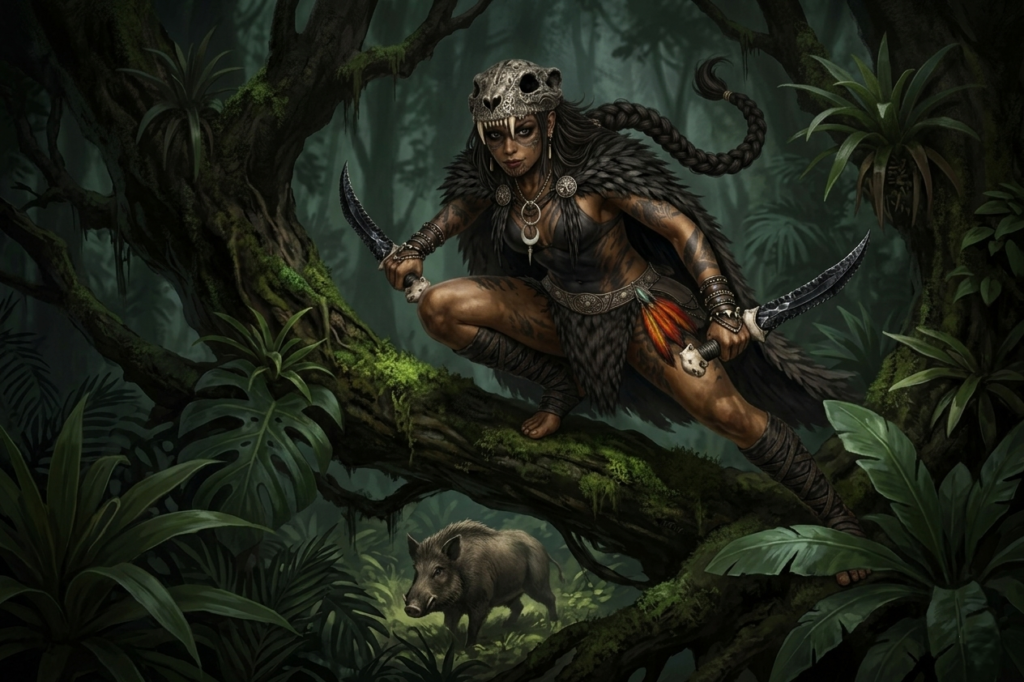
Bahla stalked from jungle trail to the hard-packed streets of Ochitla, bow in one hand, prey in the other, leaving the quiet of rustling leaves and shifting shadows for the loud jangling of civilization. The shouts and laughter of the men and women, their bustling odors and burning gazes, pressed on her awareness like the humidity before a storm, a weight that she could never get used to.
There was no peace like the peace of the jungle.
It was not the peace of talkers, who thought and thought and filled the air with words but never action. Nor the peace of shapers, who churned the earth and turned it to their own needs, who spun webs of wood and stone and trapped themselves within. Nor was it the peace of the fearful, who cowered and appeased and forgave every slight, only to do so again and again every sun.
It was a primitive peace, brutal in its simplicity. It did not pretend, it did not hesitate. Eat or be eaten. Attack or defend.
Know your place… or learn it in blood.
She was confident she knew hers, because she hadn’t just learned it; she’d earned it. This new moon, she was to be made Makaqui, a priestess to sing the souls of the dead to the stars, and appointed to the Huntress Order. Not because Xuta, the Ke’maka, the Head Priestess, had adopted her and declared it so but because Bahla had fought for it her way, with sweat and blood, not by memorizing rules and rituals.
A Huntress had no need for such silly—
Before she’d neared the temple, before she’d even crossed one of the city’s canals, two of her sister Makaqui ran at her, breathless. They wore their finest lualoas, the dresses reserved for the most sacred rituals… though they were somewhat disheveled at the moment.
“Bahla! Where have you been, the—”
“We must go to Hikepokoa! Now!” The elder of the two women, her senior by a mere three years, grabbed for her wrist.
Snatching her arm away and taking a step back, Bahla glanced over their heads at Hikepokoa, the Sun’s Hearth, the volcano rising above the city to dominate the sky and then higher still, at the bright Sun, He Who Sails the Sky. Her ceremony would not start until the Moon, She Who Climbed into Night, graced the dark sky.
Bahla scowled at the two women. Girls, really, to get so excited so soon.
“Kiama Korora, sisters.” She tilted her chin up; felt good to be the one to remind someone of their manners rather than the other way around. In her husky voice, the words were more menacing growl than the ‘Warmth and Welcome’ she was offering.
The girls’ expressions held more salt than seawater. “Kiama—”
“Leave me be. It is early yet and I must bathe.” Bahla could feel loose strands of her braid against the sweat of her back. Appearing before the Sky Gods before visiting the hot springs would be…disrespectful. She moved to brush past them.
“Maka-ku. Little Sister.” Both sisters drew themselves up straight, annoyingly tall, and put their arms out to stop her yet again. “The Ke’maka has commanded you to arrive and us to bring you. Now.”
Bahla studied the pair. It wasn’t unusual for Xuta to send someone after her for skipping lessons but there was an edge to their voices today that brought pause, stilling her retort before it burst free. She heard excitement and…something else. Not fear but close.
“Fine but surely I can—”
“No.” The older sister, who was called Lia, did not waver. “Come now or be cast from Ochitla, your vows unheard. So it is promised.”
All Bahla’s fury died at those words. Her bow dropped from nerveless fingers to clatter onto the hard-packed clay. Cast out? If the Ke’maka said it, she meant it, whatever their relationship.
“Come, maka-ku.” The younger of the two, Uhana, squeezed her hand. “All await. Even the Keepers of the Moon.”
The Keepers were waiting? They only left their Sacred Archives during the changing of seasons… or when something of great import had occurred like the foreigner invasion that took her family from her.
Bahla relented and allowed them to pull her forward. No, rather she felt compelled to move forward, to track this strange disturbance to its source. She quickly took the lead.
The trek through the city and up Hikepokoa to the summit was swift but, halfway up the slope, Lia and Uhana turned off the trail, forcing Bahla to backtrack. They weren’t going to the summit? Then where? This path led nowhere, just to a wide ledge not far above the fuming magma. Its vapors were said to bring visions from the ancestors, insights about the future like the Oracle’s…at the risk of joining those same ancestors instead.
But the sisters didn’t volunteer a reason for the detour and Bahla refused to ask.
The path briefly slid into a stone passage, plunging them into darkness for a hundred paces or so before letting them out into the caldera. Something was different today. The passage was lit with torches every few paces and, halfway through, Bahla noticed something in their light she’d somehow never seen before.
Carvings.
The stone overflowed with deep-cut images, figures whose primitive shape took away none of their impact. Human-shapes, animal-shapes, Hikepokoa shapes. And among them what could only be God-shapes, as though the divine essence of Sun and Moon and Ocean had been etched here. A feeling like pressure, unfathomable and overwhelming pressure, grew within Bahla’s chest, in her heart, the very beat and thrum of her lifeblood resonating with these sacred depictions.
As though She Who Climbed into Night and He Who Sails the Sky stood in that place with her.
A shiver went down Bahla’s spine upon seeing them and she shook her head, braided-tail lashing behind her as she tried to fight this feeling off. What this feeling was, she could not say. Not in words. A sense of deep connection and something very much like fear, but not. As though fear were too small an emotion, as though what she felt was bigger than her mind could encompass.
Like standing atop Hikepokoa and seeing She Who Endures, the great blue ocean, surround the island on all sides and stretch into forever, unbound, unbeholden, unimaginable.
Bahla barely noticed when the other two grabbed her wrists again and pulled her forward from that place. She might’ve recovered upon seeing the three dozen or so sisters waiting, or the woman who’d raised her, wearing the ceremonial raiment of the Ke’maka. The pearl-studded cape and ceremonial aqueyar-skull helm with its pair of long fangs lent her already stern face an almost terrifying air.
She might’ve recovered except she saw something in their midst that sent a chill wave over her pebbled skin. An infant, but like no child she’d ever seen before.
Their skin was the same copper hue as all islanders but it had a luminescent quality, as though the child was glowing from within. Their face was a vision of beauty and delight, unbearably pure, their eyes a solid soft-glowing gold as though their inner light had been refined and given shape.
Also, they had feathers.
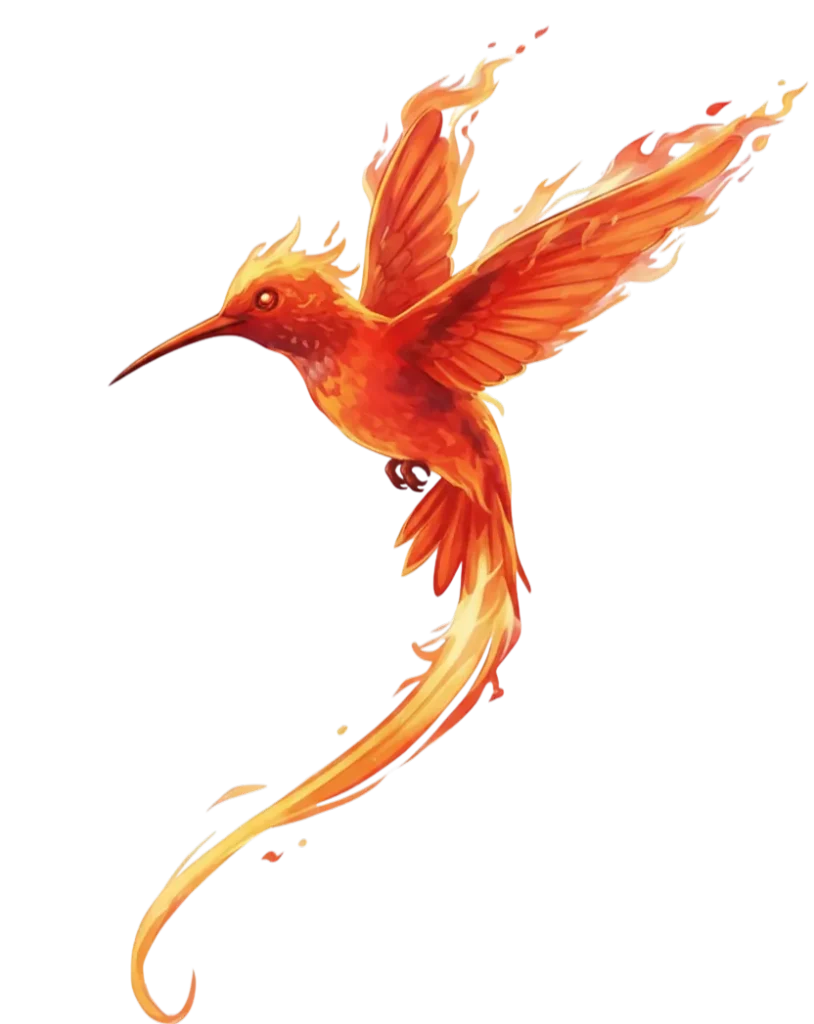
Tiny red-gold feathers grew where hair should’ve been, spilling down the child’s oversized head to a pair of small, wilted wings sprouting from their back. Which were, like any fledgling’s, spotted with red fluff and little else.
Bahla felt as though her head had been hollowed out and filled with dull, heavy clay. What kind of child was this? Where did they come from? And what did this mean for her? As she struggled against the weight of…whatever this was, the Ke’maka issued orders. Makaqui spread out across the ledge in a wide circle around the child.
“Bahla-ku, we will discuss your absence later,” hissed the Ke’maka through grit teeth, grabbing Bahla’s shoulders and pushing her to the edge of the circle beside her. “Now gather your wits and disappoint me no further.”
The familiar sound of the woman’s scolding brought Bahla fully back to her senses. She scowled, first at the Ke’maka, then at the joyful, laughing child. Though she quickly discovered she could not do so for long; glaring at the babe somehow felt…wrong.
Like cursing a fresh-formed couple for being happy.
“Kiama Korora, sisters. The Ahai’xika, the Moon’s Child, has been delivered unto us.” The Ke’maka spoke in her ritual voice, deep and rich. “Their arrival heralds a terrible struggle. But struggle offers not just failure but growth. Such always is life. Xo Maka Kiama te Kinika.”
Blessed are we in Warmth and Wisdom, repeated Bahla with the other Makaqui, a habit so ingrained she didn’t realize she’d done it until she was finished.
“Xo Aque Kukuxi te Korora.”
Righteous are we in War and Welcome.
At the sudden chorus of voices, the child finally stopped smiling; they didn’t cry or look frightened. Just solemn.
“In years to come, the Ahai will choose their own Council of Six. They will face whatever comes and they will triumph. But until then, they need our warmth to grow strong. And they need our welcome to grow kind. Kiama Korora, Ahai.”
Kiama Korora, Ahai.
“Every child, even the Ahai, needs a caretaker. But who dares claim authority over the Gods?” The Ke’maka spread her arms, gesturing at the circle. No one spoke and she nodded curtly. “Indeed, only a fool would do so. So we must wait. We must wait for the Ahai to choose their own caretaker, in the manner of old.”
Bahla found herself growing impatient; she wasn’t going to be selected, not if this infant truly possessed the wisdom of Inxika. She had no aptitude, or interest, for taking care of a child. To be stuck in the temple, responsible for a helpless mewling burden? Not for—
But then the Ke’maka did something that got her full attention.
“As it is written, she who is chosen is granted the mantle of Ke’maka.” The woman removed the symbols of her role, the aqueyar skull helm and pearl-starred cloak. “So it is promised.”
So it is done.
And Bahla’s whole world turned upside down.
She glanced around the circle of women, acutely aware that she didn’t have many friends among them. They were sisters, just not hers. She was no fool, she knew her adoptive mother had covered for her time and again, when her emotions ran hot or when she’d been abrasive when wiser heads were persuasive. And she always knew, because Xuta always made sure each failure was counted.
But she’d always expected to join the Huntresses. That was her place, where she belonged. She didn’t need to learn manners, or memorize rules, or even make friends in the jungle. She just needed herself, her senses, her skills.
Except she wasn’t Makaqui. Not yet.
Bahla looked at the child again and, for maybe the first time in her life, wished she had listened with greater care to the tales of the Gods. They would decide her fate and she was not only helpless to affect that outcome, she was clueless as to even how to begin.
So here she stood, exposed and vulnerable. She saw the shifting glances. The sideways sneers; if the child picked someone who hated her, she’d be cast out into the jungle. Not by choice. Not to protect or provide for her people. Not to hunt.
And if she wasn’t hunting…
She felt it. She felt it in the tightness of her shoulders, the erratic thump and tumble of her heartbeat, the solidity she couldn’t swallow past. Trapped. Helpless.
Afraid.
Bahla hadn’t felt like prey in ages, not since she watched her parents take their last, choking breaths in front of her. But naming it did nothing to diminish its hold. She’d made too many mistakes, too many rash decisions, too many enemies. Whomever the Ahai chose, whatever the Gods planned, she was certain this wasn’t going to end well for her.
If she could not prevent this fate, the only question left was how to face it.
Staring at the strange infant, a dozen half-learned tales whirling through her thoughts, Bahla raised her chin and bared her teeth, imagined herself a fierce aqueyar, a fearless, feline jungle lord.
* *** *
Of course all know the tale of the Moon Goddess Inxika’naiwe, She Who Climbed into Night, who dared ascend and claim divinity through her own wisdom and grace. This is the story of what came after, of pain and spite, of rage and regret. And of love.
This is the tale of Amuiwe, She Who Endures, after her daughter, a mere Pearl, rose to become Goddess of the Moon.
When Amui lost her daughter, she descended into a great and terrible wrath and for many, many seasons was better known as Tempest. She spat forth floods to cover the lands. She wove the four winds into vast storms to blacken the sky and remove from her sight the one who stole her daughter’s heart: Hikele’po, He Who Sails the Sky. Fierce and sharp did she rage at bright Hikepo. From dawn to dusk, she lashed out at him with every power at her disposal.
But at night, beneath the pale light of her daughter, Tempest wept.
She listened to the manu, the songs taught to the whales by Inxika, and she cried until her throat was raw, beating her breast until the blood flowed in great red waves. She wept so much and so often that the ocean turned salty with her tears.
Amui, wise Amui, had once given the world all she had to give, creating all that swam and walked and flew. But Tempest knew only of what was lost. What was taken. And so, in her fury, she devised a plot most cunning.
She searched the world wide for just the right materials. The needle from a manta’s sting. The trunk of a roa tree, struck with lightning and black as death. A viper’s deadly venom and a spider’s invisible thread. These she collected one by one; she carved the black roa into a spear shaft and wove the spider silk into a rope as light as clouds and long as the sky, tying to the butt of the spear so it could be retrieved. She soaked the manta’s needle in venom until it also turned black, binding it to the tip of her spear.
Tempest gazed upon this wicked all-black weapon she’d wrought and named it Spite, and even the Gods could not escape its bite. Then she waited for Hikepo to fall to rest within Hikepokoa. And for Inxika to rise.
As her daughter took her place within the night sky, Tempest launched her spear upward. Spite rose and rose until it barely pierced the Moon from below, then she pulled it back to her. It left a tiny prick, not enough to kill her daughter, but enough to make one bleed.
As she hid the evidence in the deepest, darkest part of her, Tempest was pleased.
When Hikepo woke, he would see his wife, her daughter, wounded and bleeding without apparent cause. A sickness perhaps. A weakness for certain. And he would abandon her, because that was his brash, brutish way. He cared only for the strong. Then Inxika would return to her mother’s welcoming arms.
It was a perfect plan.
Except when Inxika claimed night as her own, she took with her most of the ocean’s wisdom and so Tempest, who was once Amui, failed to account for two possibilities:
First, that Hikepo might not abandon Inxika. Which he did not; indeed, distraught as he was on her behalf, he hovered closer than ever, using his fire to burn out the venom. But so great was the resentment infused within it that despite all his might, he could not stop the bleeding. He could only prevent it from festering.
Second, and more importantly, Tempest had not realized how unbearable her daughter’s suffering would be to her.
When Inxika, when her sweet, beloved daughter cried out in pain, Amui knew a hurt worse than any other she had ever known. Her child was suffering and by her own hand. The shadow of regret spread through her then, colder than ice, cold enough to freeze her core, the remnants of which can still be seen.
Amui immediately set to remedy her mistake but some things can never be undone.
When her power combined with Hikepo’s, opposites in harmony, the wound caused by Spite was suppressed…suppressed but not healed. A few days each mooncycle, Inxika’s wound would reopen and bleed again. And so pernicious was that poison that it infected even the people of the world with Iximi’xika, the Moon’s Curse.
But just as the damage from Tempest’s pain could not be reversed, the power of Amui’s love could not be denied.
When Amui and Hikepo had created life, they had made all the animals of the world in pairs so that none could create new life again without joining together. But these new creatures, they were too concerned with their own lives to be concerned with another’s. They had too much of Hikepo in them, his pride, his strength, his stubbornness, and every attempt at cooperation turned to a fight for dominance.
There could be no cooperation without wisdom, no peace without understanding. And to understand another, one must first need them. And to need is to be made vulnerable. Vulnerability becomes compassion and compassion becomes the bridge to connection.
For all that Amui came to regret her wrath as Tempest, it led to something that the world did not have before that:
Children.
Stars shift, seasons change, and Amui’s tides ebb and flow. Hikepo and Inxika endlessly follow each other, a cycle of chase and retreat that carries the world relentlessly onward. Mistakes cannot be avoided and no peace is permanent, but neither is any conflict irreconcilable. Children can transform the regrets of yesterday into hope for tomorrow, so long as one keeps Warmth and Welcome close to heart.
* *** *
In the Tameo’maka, the sacred temple of the Makaqui at the center of Ochitla village, a new era had announced itself over these past six mooncycles with a volume it hadn’t experienced in some time. Not in the cries of an ill-tempered infant but rather from the frustrated howling of a new mother.
“Mango cannot be harvested from a roa tree, aqueyar cannot fly, and I cannot learn all these stupid rules and rituals!” Though, on this day, Bahla’s outburst wasn’t directed at the feathered child, given the name Keylon, but at her own adoptive mother. “Leave me be!”
Keylon seemed delighted by the sudden outburst and crawled across the cramped room toward Bahla with squeals of mimicked outrage, eager to join the ‘game’. For a being that was supposed to have the wisdom of Inxika, they made a lot of questionable choices.
The first of which was choosing her as their caretaker.
With a suppressed curse, Bahla picked Keylon up, balancing them on her hip. They immediately grabbed for her poor, frayed braid. She grimaced but resisted the urge to pull away.
“Bahla-ku! This is too important for you to fail.” Xuta reached out to take Keylon away. “All of Ochitla now depends on the wisdom I have not yet succeeded in instilling.”
Keylon pulled tighter on her tail.
“All the world depends on the Ahai, not me.” Bahla twisted to put herself between Xuta and the Ahai. Despite everything, she’d developed a grudging fondness for the sweet child.
Even if their clinginess made her feel trapped sometimes.
“Fine, keep the Ahai. But you must focus.” Xuta gestured outward, toward the world beyond the small room. “The changing of seasons comes soon, the rituals still do not live within you as they should, and we have barely begun your instruction on the murals. You haven’t even moved into the Ke’maka’s chambers with me. You force me to come here every day, under the stares of the sisters. The more you avoid, the more unfit we appear to those around you.”
“My room was fine before and it’s fine now!” Bahla wanted to kick the woman out and block the door. Sure, her room was small but it was hers. Even though it looked (and smelled) like a beast’s cave, it was the only place she could seek refuge anymore; she hadn’t been able to go hunting since this damned child appeared. “And I avoid nothing! I am trying to learn!”
Indeed, Bahla had never tried harder at anything in her life than she tried to learn all the lore and songs and rituals. But it just…wouldn’t stay in her head. She couldn’t keep from being distracted, couldn’t keep the details straight. Whatever curse stopped her from learning from her lessons so far seemed magnified now, worsened and not just because of Keylon.
She felt the stares, heard the murmurs as everyone watched and listened and knew. She wasn’t fit to be Ke’maka. Even Bahla herself knew she belonged in the jungle. This wasn’t her place. And knowing made it that much harder to deny Xuta’s sharp tongue.
“Trying is not sufficient.” The woman crossed her arms like she always did when Bahla disappointed her; it was a familiar move. “You know what I have done for you. The costs I paid. Now you have a chance to repay not just me, not just Ochitla, but all of Akiponahai.”
In the close confines of her room, child in her arms, this woman in her face, the weight of her unasked-for role pressed on Bahla with the weight of the world itself. A need rose within her, as it had so often over the past few mooncycles, a need to run, escape, to close her eyes and blindly flee.
But there was no escape for her. Not anymore.
Keylon needed her. The Makaqui needed her. Ochitla and Akiponahai and the whole world needed her, as Xuta kept pointing out. So she had to stay, with no one to confide in, to share her fears or help her carry her burdens. Nothing she could face in the ways she knew best. Just unrelenting pressure.
Eyes stinging, Bahla fought against a swell of emotion, knowing if she let go, if she stopped fighting, it might never stop. She hadn’t asked for this, didn’t want it, couldn’t bear it any—
Keylon reached up their chubby little arms and wrapped them around her neck, plastering a big, sloppy, open-mouthed kiss against her cheek. In their golden eyes was a solemnity, a depth far beyond their years, the wisdom of eternity.
The wisdom of a god. Even if a baby one.
Bahla hugged them tight, burying her face in their scent, a strangely spicy-sweet smell that didn’t quite hide the whiff of slight sourness that suggested the child needed changing. Again.
“Heed my words! You must—”
“I must what?” Like a flash flood colliding with an immovable boulder, all that pent-up pressure overflowed and jumped from one course to another. This one was far more familiar and comfortable to her. “What must I, the Ke’maka do? What must I, who was selected by the Ahai’xika, by the Sky Gods themselves, do? Tell me, mother. Tell me again what I. MUST. DO.”
Bahla, the Ke’maka, wiped slobber off her cheek and set Keylon down on her pile of bedding.
“Never again speak to your Ke’maka of what she must and must not do.” She spun round and took a step toward Xuta, grabbed onto a surge of righteous energy and held it with all her might. Never again would she allow anyone to make her feel lost and small. “Leave me now and do not return until you have reflected and repented on your failures.”
The woman stiffened. “Bahla-ku—”
“I am Ke’maka! I am your Ke’maka.” Bahla took a step into her personal space, realizing for the first time that she’d grown taller than the woman who raised her. “You will address me properly or not at all.”
“I did not…” Xuta shook her head and her mouth set in a hard line. “I see you are not ready and so I will leave. But hear me now, Ke’maka. If you cannot admit your mistakes here, you will regret—”
“I regret nothing.” Bahla marched stiff-legged for the door and kicked it open, if only so she didn’t kick the older woman. “And the Ke’maka does not apologize.”
Scorn poorly concealed, Xuta nodded and moved for the door. As she passed, Bahla thrust a hand out, stopping her cold. The differences between them, their physiques, had never been more noticeable than in that one moment, that one touch.
“Those blades do not belong to you.” Bahla did not need to gesture at the two obsidian daggers in the woman’s belt, the ones her once-mother, the once-Ke’maka seemed to have forgotten to turn over.
The pair of black blades came out in a flash, held tight as a secret before being relinquished. As Bahla took them, she marveled at how well they seemed to fit in her hands.
Xuta barely kept a sneer off her face. “Kiama Korora, Ke’maka.”
“Do not return. Mother.” Bahla closed the door on her with a finality that seemed to resonate throughout her room.
She turned back toward Keylon, alone with her in the room, to attend to them only to see, for the first time ever, tears. They weren’t wailing out loud as a child should, but silently, twin streams spilling from their golden eyes down their round cheeks.
Bahla reached out to them and only then noticed the blood dripping from her hand. And, now that she saw the wound, pain finally registered and she winced. Her glance fell to the obsidian, Gods-blessed blades and she knew again the fear and awe she’d come to know well since Keylon appeared.
How sharp were they that she could cut herself so deeply and not notice?
“Do not fret Key-ku—” No, that didn’t feel right. She set the daggers aside carefully before smiling at Keylon. “Do not fret, kiahai, warmth of my heart. This hurt is temporary and I am strong.”
The child just stared with tears streaming down. Of course they didn’t understand her, what was she thinking? But before she could comfort them, she first had to take care of her own hurt.
We call out to all who watch, come to us in our need,
Come, come, Ancestors above and spirits of the island
Come, come, Warmth and Wisdom and enduring Waves
Come hear our plea—
Bahla had already reflexively begun the manu’xika, the moonsong of healing, before realizing there was no voice to join hers. And no moonsong could take shape in solitude.
She briefly contemplated finding someone to help and shook her head. The others were already struggling to accept her as Ke’maka, she didn’t need them to know she’d cut herself on her own daggers.
And there was no way she’d ask Xuta. Not in this life.
“Just you and me now, kiahai.” She glanced at the child. “Too bad you can’t sing with me yet.”
Instead, Bahla went to a small set of clay jars, opening one to reveal a pungent salve which she spread across the wound before bandaging it. At least it should heal quickly; despite how deep it ran, the cut was clean.
When she finished, she went to the still-weeping child and picked them up. As she did, her eyesight seemed to flicker for a moment, as though there’d been a flash of light within her room, stronger than the candles could’ve created. Her wound throbbed briefly and then the pain seemed to diminish, as the moon ivy in the salve began its sacred work.
She could be Ke’maka. She just needed to do it her way.
“See, kiahai? No need for tears.” Bahla hugged the child again, tighter than before, allowing herself a moment of weakness before pulling away. She wrinkled her nose at their overripe smell. “Now, let us see about a change.”